Ebb & Flow

Timekeeping—and therefore, time and its passing—as a negotiation of stages of re–materializations and re–scalings in search for an invariance to map itself to.
Hence follows the paradox of a constantly redefined time that re–fines itself.

the time that appears and disappears in cycles: solar time
scale down

the time that appears and disappears in phases: lunar time
further down

the time that appears to appear and disappear in cycles: solar time
steal > scale down (to us) > materialize

the time that flows up, into the present: time stolen
scale down > re-materialize > atomize > invert

the time that flows from a contained future into the past: hourglass time
re-materialize > invert

the time that has a prefigured future, lights up the present and burns away into the past: luminous time
scale down > mechanize > reproduce

the time that is no longer given nor stolen: time owned and reproduced
scale down > atomize > quartz

the time that syncs up with matter at atomic level: crystal time
scale down > trade > dematerialize

the time that syncs up networks and aligns trading: HFT time
scale down > algorithmic time > …

.

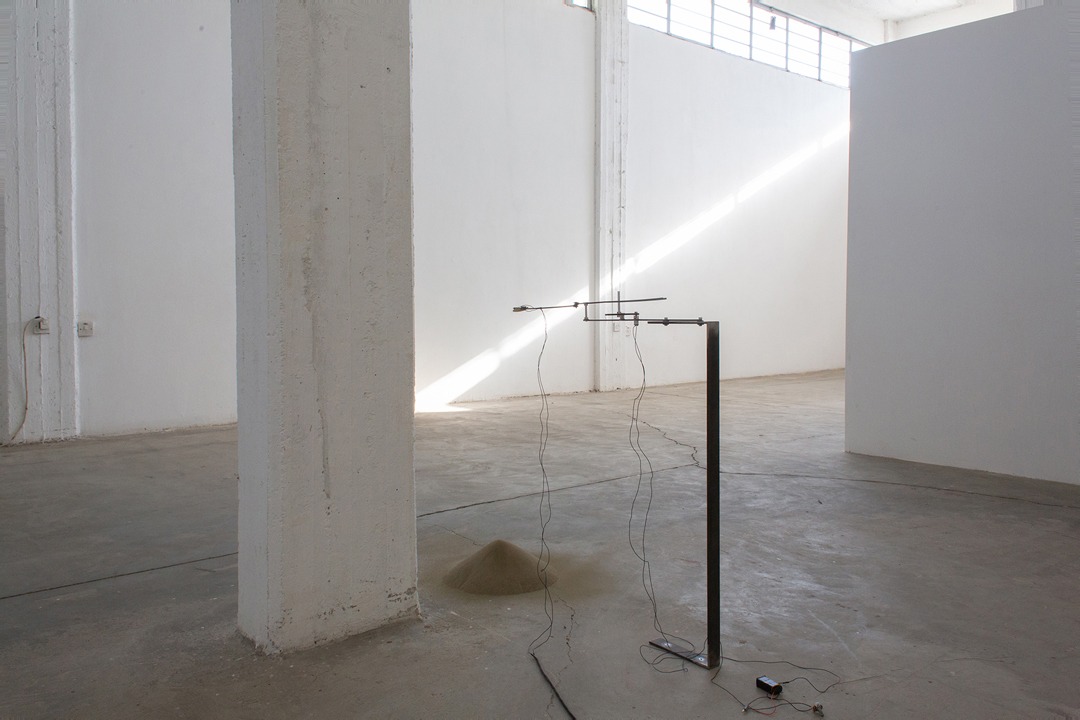
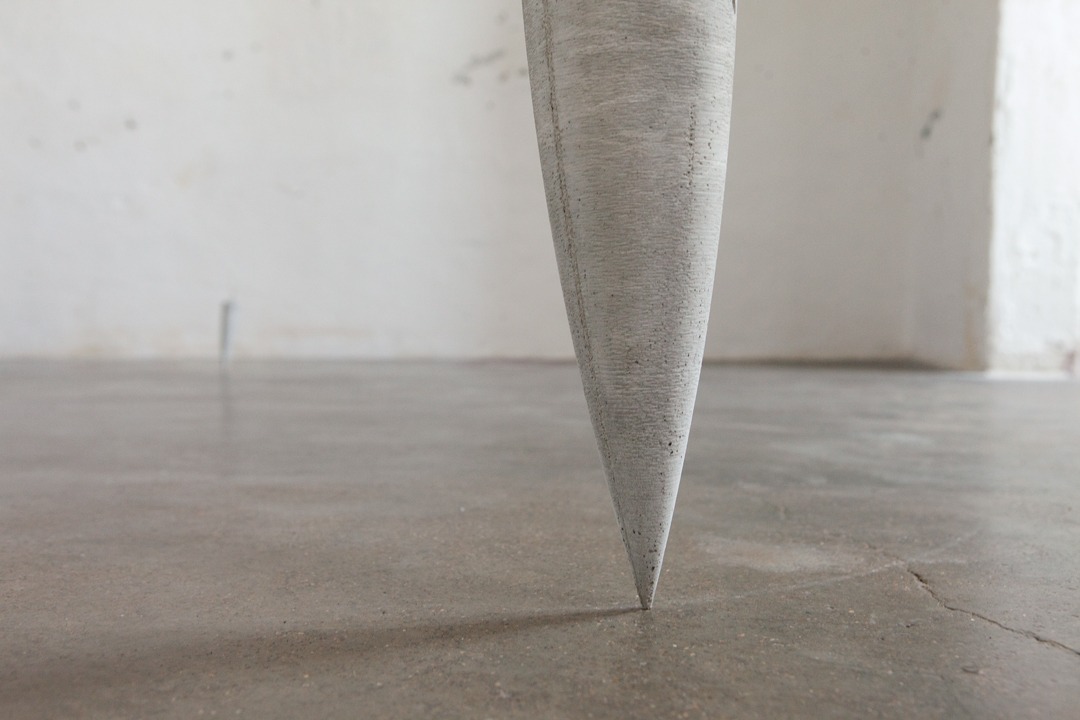
Ebb & Flow is a sound installation by Shammaes that brings together their respective interests in sound, design and architecture. The installation itself collides classic dualities, but by placing them in direct confrontation it ends up problematizing them.

mechanics and dynamics.
automata and avalanches.
harmonic and chaotic.

As time changes so do sounds and their convolution. The mechanical oscillation’s contact with soil is done at the expense of harmonicity and constancy. In some sense then, this form of oscillation resembles more and more to some other, more primordial ones; namely, that of a tide’s ebb and flow.

text by Emiddio Vasquez
Design Pamphlet

Two-body problem

Two bodies were still enough for the algae to break down. Sedimenting, into nu-matter.

Flooding maps into new atlases, undulating out of history and into the deep ocean: the outer was all along the inner. But the truth of the matter is that water cycles simply couldn’t keep up with development. Well into the post-Silicone era, some Neo-materialists keep referring to it as “concrete computation”.

This is why I am standing on this deck, waiting for the new ellipse.

According to my computations, the ebb will be great enough for the needed thrust to reach Villa da Furna. If rumors are true, then there should be some early nu at the edge of the village. I am not sure of the specifics but I would have around ninety-two minutes to sort that out and catch the final flow back.

Will they buy it? Who knows…Ever since the hypersea flooded the markets new futures emerge at hyphal rates, adapting to new models, making other ones redundant. This is why I miss the chaos blind training days. In all its ambiguity, matter spontaneously bound structure with energy and we reacted accordingly. That was its de facto regulatory function. Until we reached its limit, the tangent was all along inflected, infinitely, into the sub-ocean. Hence the postulate of a nu source. And paradoxically a return to the atom, not so much as droplets in the oceans, but as oceans in every droplet.

This is why I am standing on this deck, waiting for the new ellipse. This is also why this will be my last dive.

text by Oswaldo Hadjilyra

Envelope

Algorithmic content created for Envelope II Festival at Testdrive, Nicosia [CY], December 2017.
A celebration of analog/modular synthesis and live electronic music, Envelope Festival presents various local artists to perform their latest work.

Live Music Performances by

White— Whirl-DOS + Uvglov
Green— αίθερ λίνα
Blue— Mihalis Sham
Red— elektroniki
Silver— Oswaldo III

The Irrational Instrument

The Irrational Instrument is a narrative on continuity, as seen through the dipole of object and sound. By object and sound I refer to the object (as designed and manufactured geometry) able to produce a specific sound and inversely the sound (as experienced timbre) which can not be produced by any other than that specific object.

Moving across references by Dedekind, Leibniz, Deleuze, Badiou, the project examines the creation of three abstract machines which are trained by an initial set of existing objects (rationals) in order to create a symbolic space as receptacle of new unknown objects (irrationals).

Breaking down the input objects into numerical entities and working primarily with the Principal Component Analysis algorithm, a tool is offered to infiltrate the intermediate space of uncertainty, to design not objects but possibility spaces where populations of abstract objects are found. By drawing a line of flight, we stumble upon this open world; and it is a world inhabited by nomadic, familiar yet alien artifacts.

[original text excerpt] “The space within which this object emerges is not an empty space but it possesses laws (νόμους) while remaining a smooth space. It is an a priori shaped by the machine space, has intensities, pushes and pulls, areas of relaxation or of extreme density, valleys and mountains of less or more probability of existence. There, new objects can present themselves, can be summoned as fragile moments—or cases—of a field of smoothness.”

Things inside other things

17:00–18:00.
Four one–hour recordings are made in four main locations of the divided city of Nicosia.

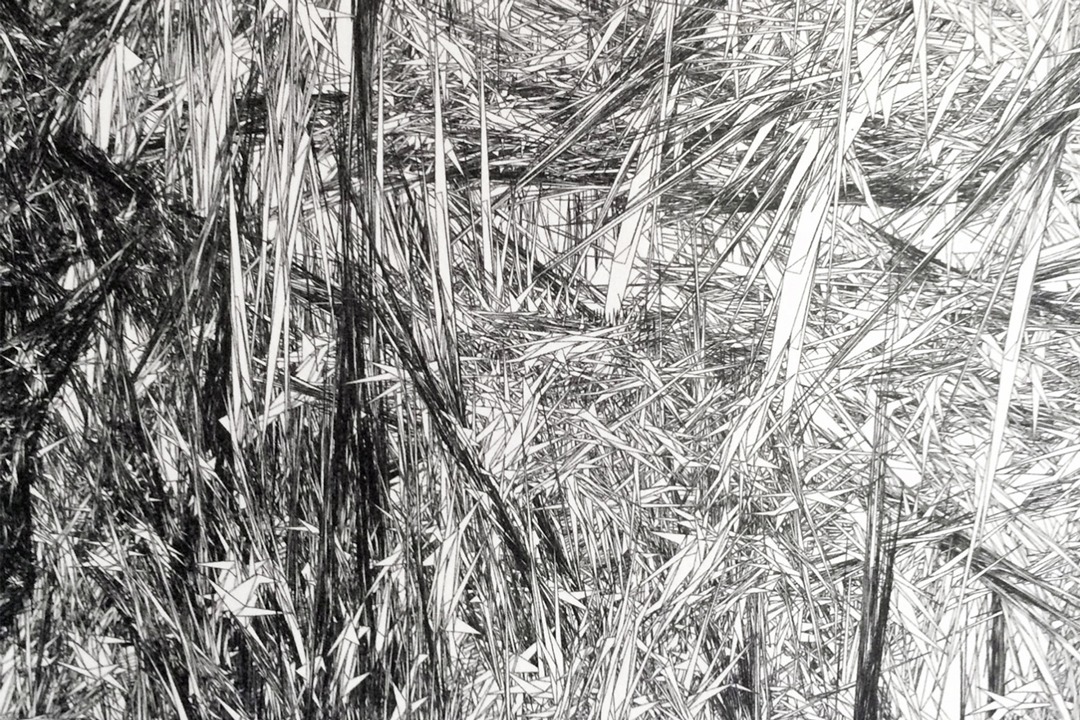
The empty canvas follows a subdivision process driven by the numerical values of the city’s soundscape. As the output moves towards ambiguity and all recognizable elements disappear, the observer is confronted with an abstract map that no longer carries cultural characteristics of ‘this’ or ‘the other’ community, nor does it force comparative connotations. It is instead offered as an unsolvable riddle, a new kind of city map generated by the city itself.

The produced drawing’s constellations emerge at manifold scales, as the algorithms determine the overall form as well as generate the various microscopic details. The drawings, though computationally designed, exist as such only in printed form, where the visibility of each of their components is directly related to the observer’s distance.