From structure to skin, from memory to form, from control to surrender

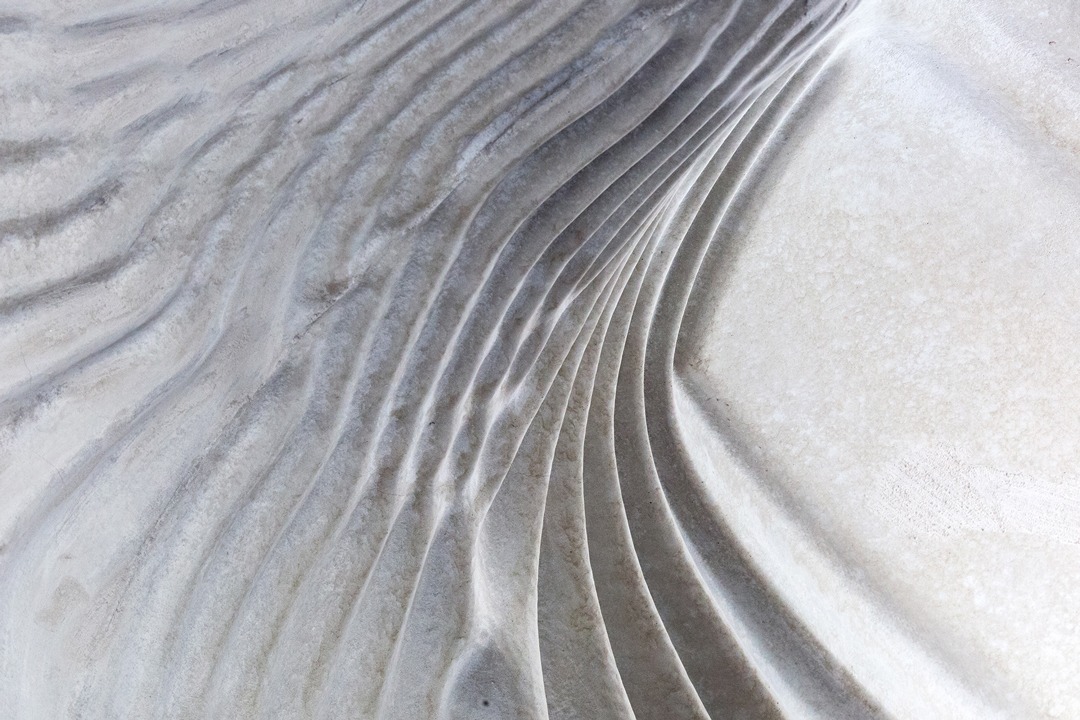
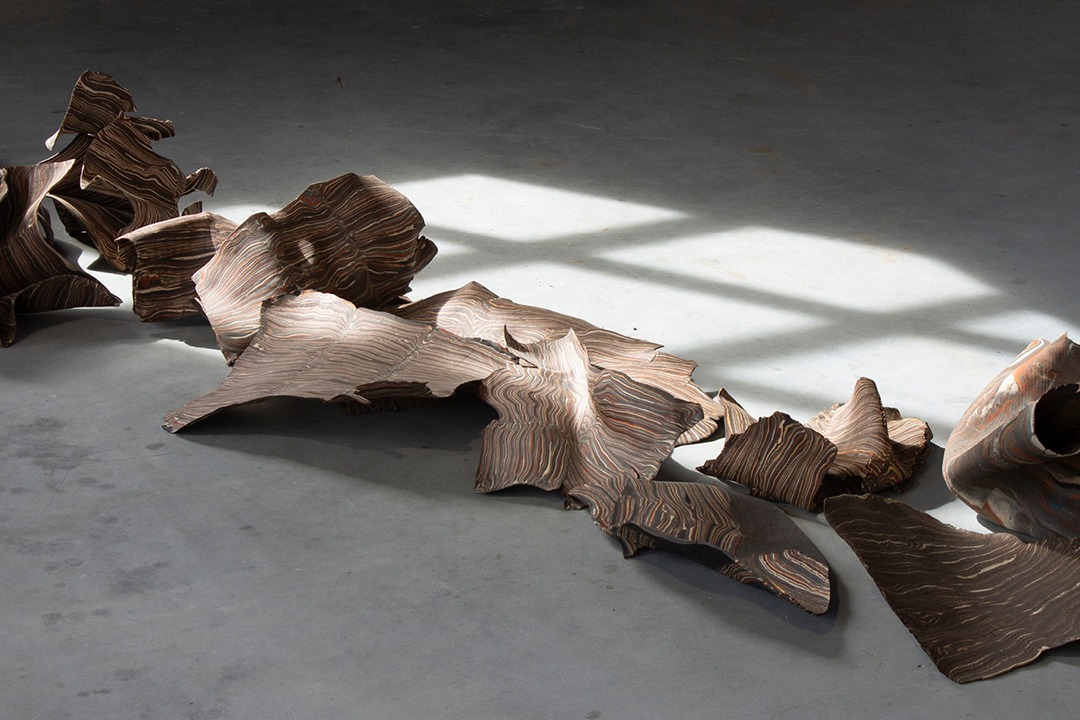
Form disassembles and reconfigures itself through physical process, stress, and time. Here, this quest for transformation is enacted through composite bodies made from different types of clay. The process unravels with an embedded structure: a logic of stratification, a repeated slicing, stacking, and compression that generates its own internal rhythm.

One series gives way to fragile, curling sheets, appearing as skins, leaves, fragments of bark, alluding to erosion and decay. They seem to collapse under their own weight, cracking and folding against intention. The process itself, improvised and spontaneous in its foundation, causes the pieces to begin breaking apart at every stage of their making: forming, drying, firing. Collapse becomes formation and formation becomes collapse, rendering the objects into events: episodes of material strain, where layered process and structural failure unfold as a singular gesture.

In another sequence, pieces pressed onto a mould taken from a tree branch take on the appearance of petrified remnants. Through the same striated logic, the process is one of impressionistic mutation. Clay appears as a tree branch to stand as both fossil and fiction. Here, imitation becomes a form of listening, an attunement to the silent logics of growth, decay, and renewal. Following a biomimetic instinct, identity is assembled through layered performance, and like camouflage in the forest, the forms and their patterns blur the boundary where resemblance both conceals and reveals artifice.

A third gesture engages pattern directly: a recognisable tessellated motif begins to deform, lifting from the ground, folding onto walls and columns, slumping under invisible heat. Geometry becomes pliable, optical stability and pattern repetition yield to gravitational pull. The rigid and the measured begin to be a subject of pressure, fatigue, and time.

The three streams explore a shared language of transformation: from structure to skin, from memory to form, from control to surrender. Each piece is more a residue of a negotiation between material behavior and encoded process. The works inhabit a space between emergence and erosion, architecture and accident. What emerges is a slow unraveling—an embrace of the moment where things fall apart, and begin again.

text put together by dd
Woven Clay

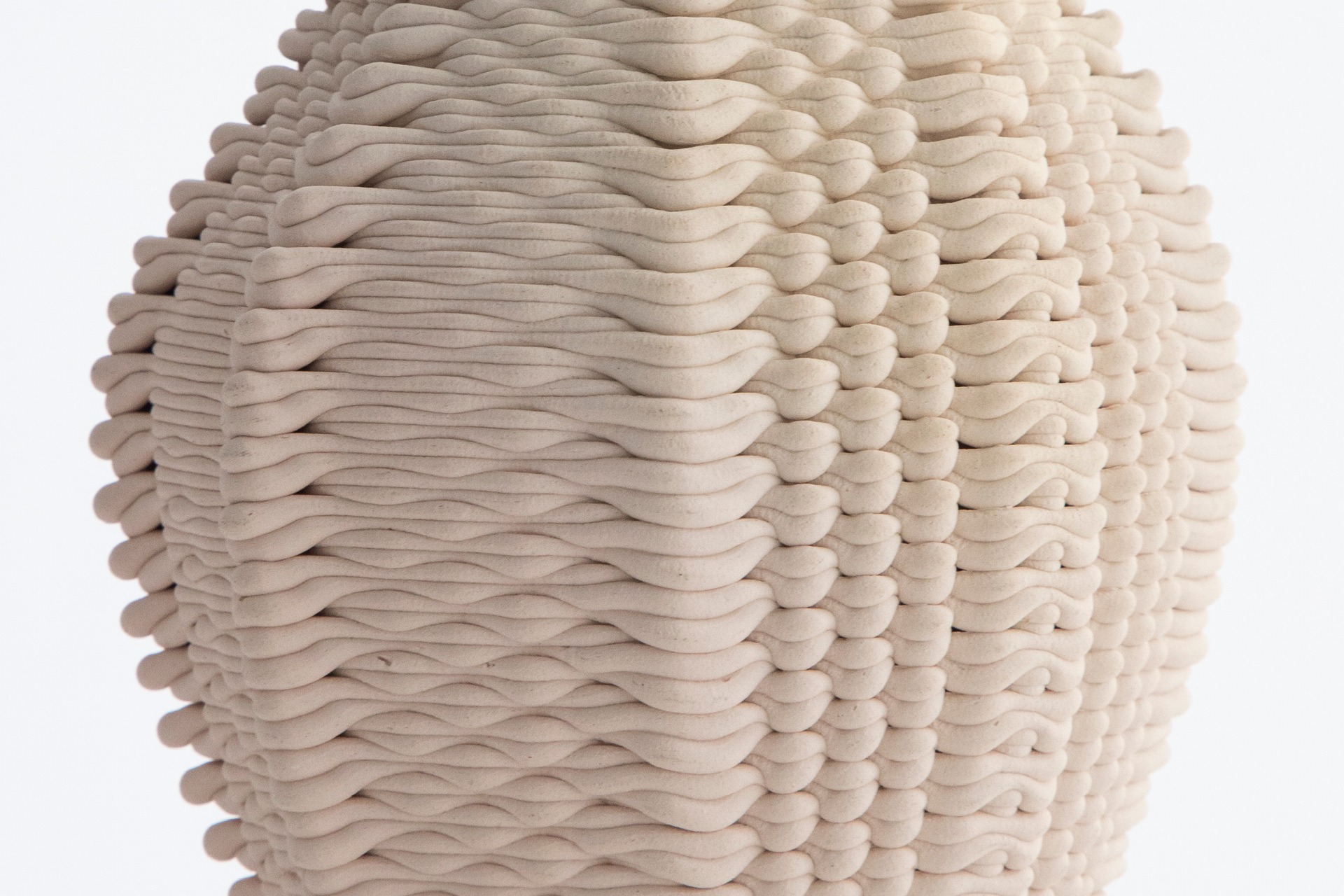
Woven Clay explores the possibilities of ceramic 3D printing by reimagining the object as an intertwining line in space—a thread. The ceramic pieces embody the essence of woven fabrics, knitting, or basketry. Their texture, rhythm, undulations, and repetitions, emerge from the interplay between a predetermined programmable toolpath and the unpredictability of clay, its plasticity and behavior under gravity loads.

Smart Slab

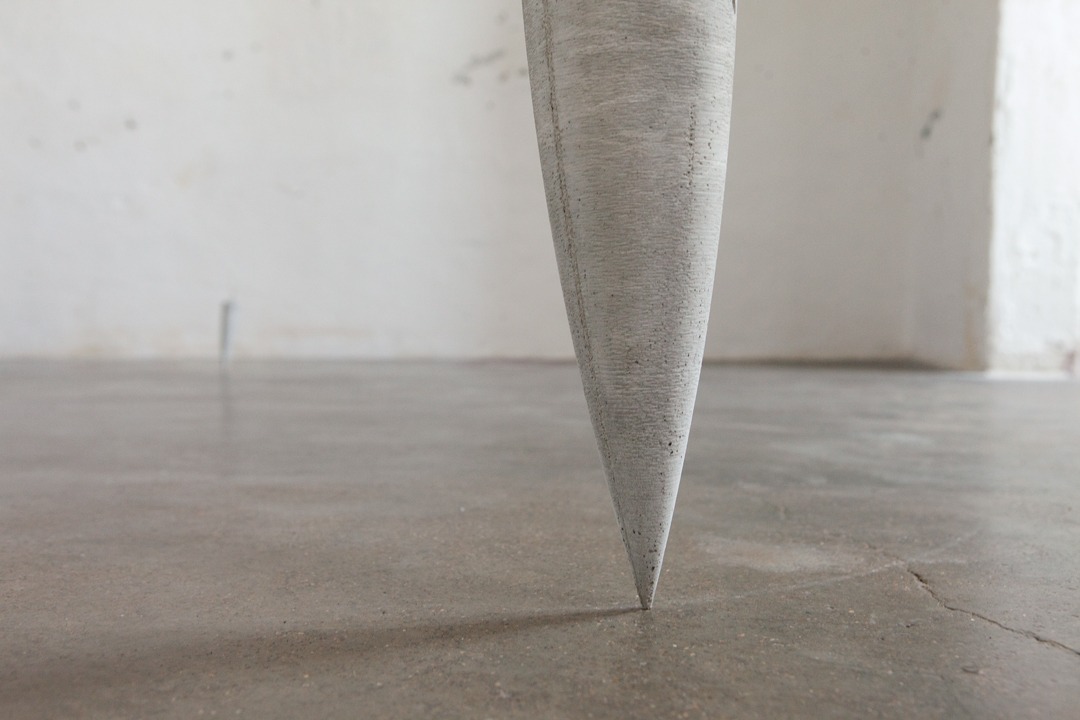
Smart Slab is the first concrete slab fabricated with a 3D-printed formwork. 3D printing overcomes the geometric limitations of traditional formwork fabrication methods. Furthermore, it enables the construction of integrative concrete elements with elaborate, free-form and highly detailed surfaces and smart construction details. 3D printing has the added benefit that geometric complexity and differentiation come at no additional production cost.

The 78-square-meter Smart Slab that is fabricated for the DFAB House, cantilevers over the S-shaped Mesh Mould wall and carries the two-story timber unit above it. The Smart Slab comprises eleven 7.4-meter-long segments which are prefabricated and then mechanically joined using post-tensioning cables.

The geometry of the Smart Slab is structurally optimized for its challenging load-case, involving cantilevers of up to 4.5 meters. The material is distributed in a hierarchical grid of curved ribs, which vary between 30 and 60 centimeters in depth. The 1.5 cm thick concrete fields between these ribs are domed to maximize stability and to minimize the amount of material needed. Consequently the slab only weighs 15 tonnes, almost 70% less in comparison to a conventional solid concrete slab.

Ebb & Flow

Timekeeping—and therefore, time and its passing—as a negotiation of stages of re–materializations and re–scalings in search for an invariance to map itself to.
Hence follows the paradox of a constantly redefined time that re–fines itself.

the time that appears and disappears in cycles: solar time
scale down

the time that appears and disappears in phases: lunar time
further down

the time that appears to appear and disappear in cycles: solar time
steal > scale down (to us) > materialize

the time that flows up, into the present: time stolen
scale down > re-materialize > atomize > invert

the time that flows from a contained future into the past: hourglass time
re-materialize > invert

the time that has a prefigured future, lights up the present and burns away into the past: luminous time
scale down > mechanize > reproduce

the time that is no longer given nor stolen: time owned and reproduced
scale down > atomize > quartz

the time that syncs up with matter at atomic level: crystal time
scale down > trade > dematerialize

the time that syncs up networks and aligns trading: HFT time
scale down > algorithmic time > …

.

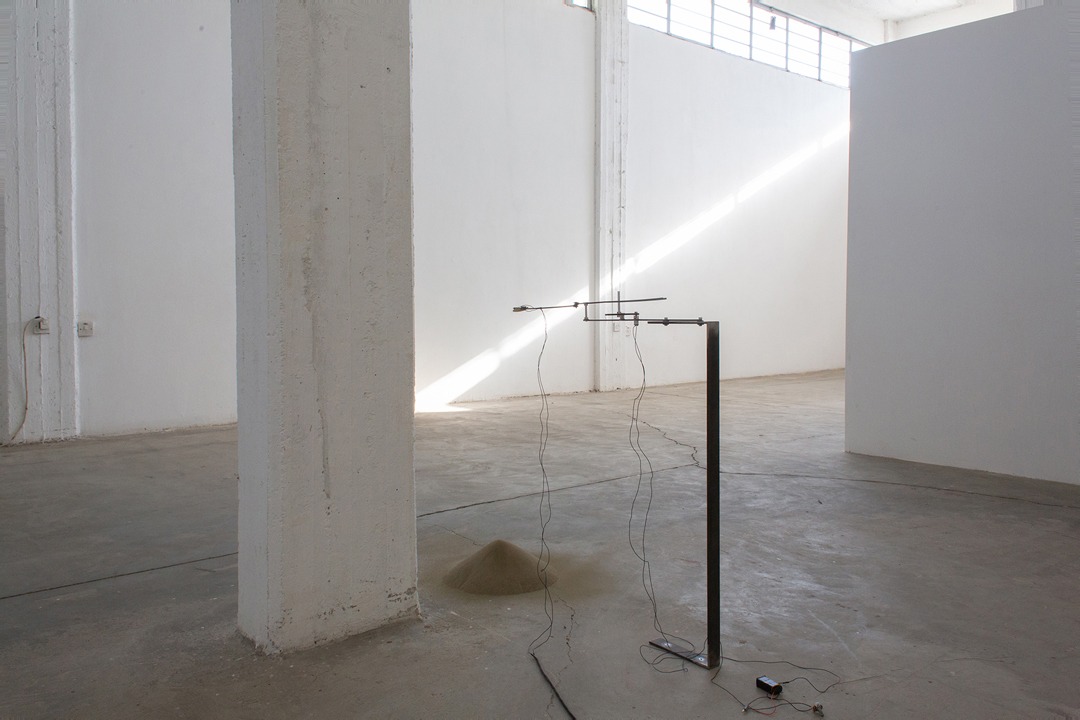
Ebb & Flow is a sound installation by Shammaes that brings together their respective interests in sound, design and architecture. The installation itself collides classic dualities, but by placing them in direct confrontation it ends up problematizing them.

mechanics and dynamics.
automata and avalanches.
harmonic and chaotic.

As time changes so do sounds and their convolution. The mechanical oscillation’s contact with soil is done at the expense of harmonicity and constancy. In some sense then, this form of oscillation resembles more and more to some other, more primordial ones; namely, that of a tide’s ebb and flow.

text by Emiddio Vasquez

Design Pamphlet

Two-body problem

Two bodies were still enough for the algae to break down. Sedimenting, into nu-matter.

Flooding maps into new atlases, undulating out of history and into the deep ocean: the outer was all along the inner. But the truth of the matter is that water cycles simply couldn’t keep up with development. Well into the post-Silicone era, some Neo-materialists keep referring to it as “concrete computation”.

This is why I am standing on this deck, waiting for the new ellipse.

According to my computations, the ebb will be great enough for the needed thrust to reach Villa da Furna. If rumors are true, then there should be some early nu at the edge of the village. I am not sure of the specifics but I would have around ninety-two minutes to sort that out and catch the final flow back.

Will they buy it? Who knows…Ever since the hypersea flooded the markets new futures emerge at hyphal rates, adapting to new models, making other ones redundant. This is why I miss the chaos blind training days. In all its ambiguity, matter spontaneously bound structure with energy and we reacted accordingly. That was its de facto regulatory function. Until we reached its limit, the tangent was all along inflected, infinitely, into the sub-ocean. Hence the postulate of a nu source. And paradoxically a return to the atom, not so much as droplets in the oceans, but as oceans in every droplet.

This is why I am standing on this deck, waiting for the new ellipse. This is also why this will be my last dive.

text by Oswaldo Hadjilyra

Dishonest

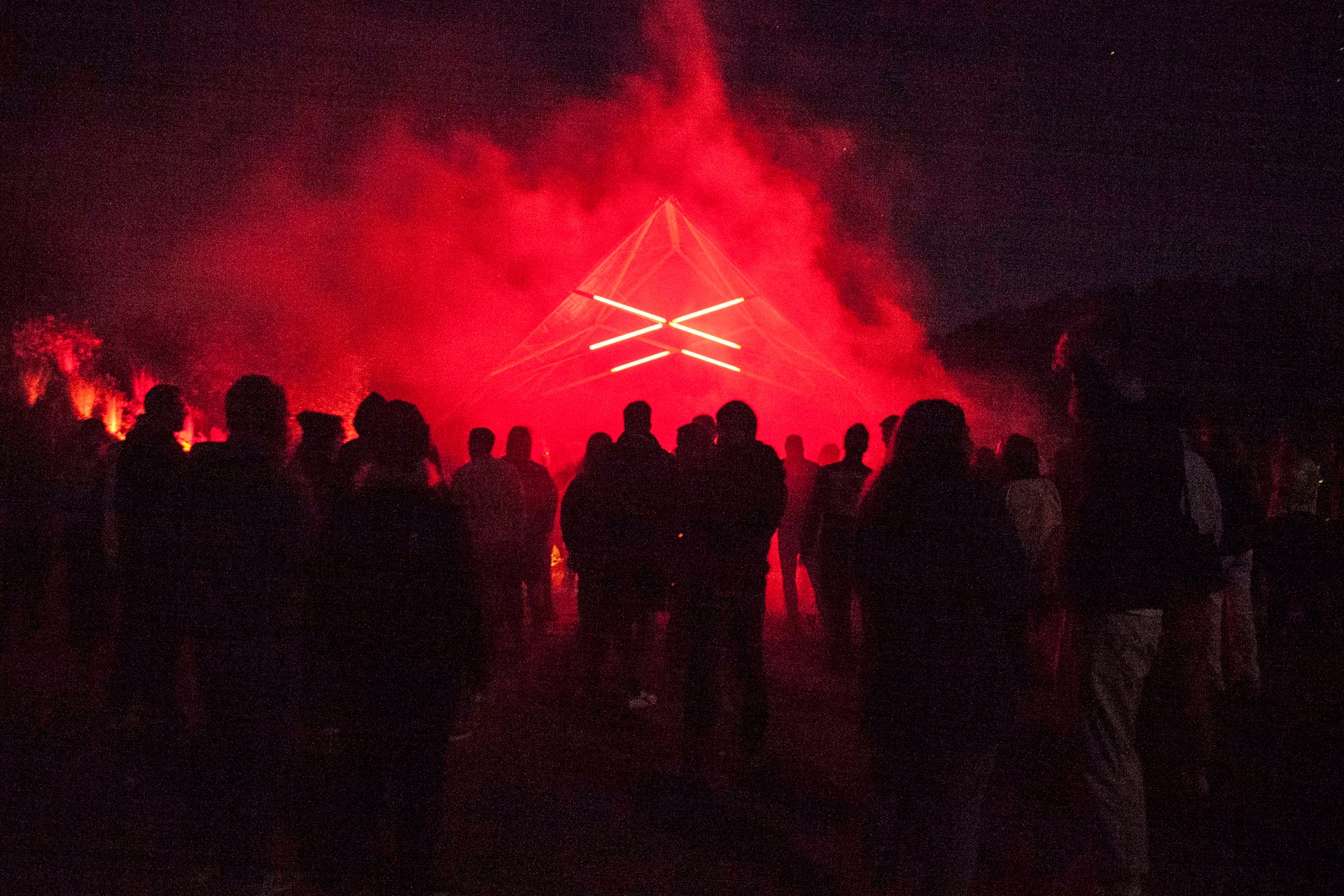
Volcano Stage Design and Construction for DISHONEST II — Outdoor Mini-Festival.